
Hing
The dried resin of a giant fennel from the mountains of Afghanistan and Iran. Pungent in the jar, it turns warm and savoury, almost onion-like, in hot ghee.
- Settles Vata
- Settles Kapha
- Can raise Pitta
How Ayurveda reads hing
- Rasa · taste
- Pungent (kaṭu)
- Guṇa · nature
- Light, unctuous, sharp (laghu, snigdha, tīkṣṇa)
- Vīrya · potency
- Heating (uṣṇa)
- Vipāka · after digestion
- Pungent (kaṭu)
- Part used
- Oleo-gum resin
Reviewed by the Vapika team.
In the tradition
Hing has been traded into India from the passes of the north-west for more than two thousand years. It did not grow here until 2020, when the first plants were set in Lahaul-Spiti. Caraka singles it out among resins, in his list of the foremost substances, for its action on digestion and on Vata.
Pure hing is a hard resin too strong to use straight. Most kitchens use compounded hing: resin ground with flour and a little gum.
How Ayurveda reads it
Hing is pungent, light, unctuous and sharp, and heating. It is described as kindling the digestive fire and moving Vata downward (anulomana), and as settling Vata and Kapha.
In the Indian kitchen
A pinch in the tadka for every dal, in kadhi, sambar and rasam, and in the masala for chole and aloo. Jain and many Vaishnav kitchens, which leave out onion and garlic, rely on it for the savoury depth those would give.
How we use it
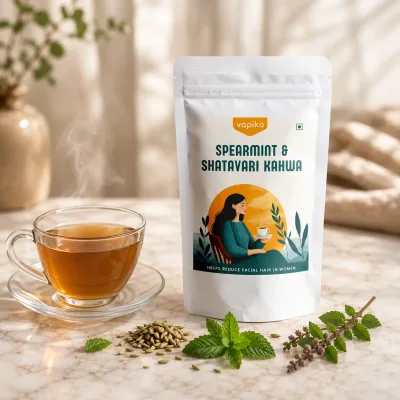
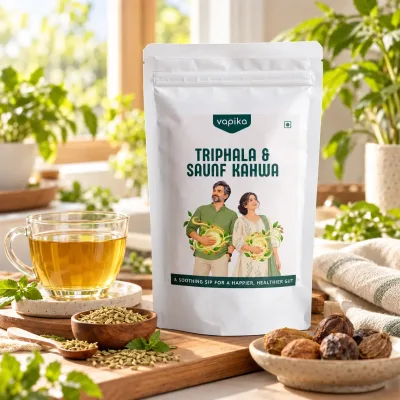
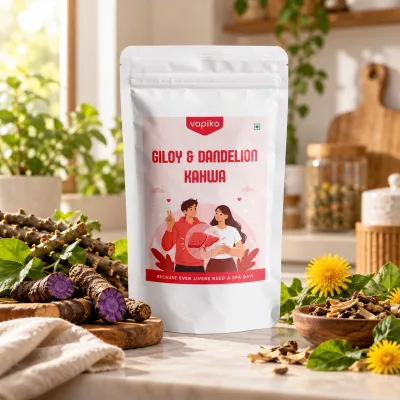
We use a tiny amount of compounded hing in our Triphala & Saunf, Giloy & Dandelion and Spearmint & Shatavari kahwas, for depth rather than flavour.
From the texts: Caraka Saṃhitā, Sūtrasthāna 25 (agrya: hiṅgu niryāsa as chedanīya, dīpanīya, anulomika); Bhāvaprakāśa Nighaṇṭu, Harītakyādi varga.
For learning, not diagnosis. If you are pregnant, nursing or on medication, please speak to your doctor first.