
Dashamoola
Ten roots, five from trees and five from small plants, boiled together. Dashamoola is one of the oldest and most used formulas in Ayurveda.
- Settles Vata
- Settles Kapha
How Ayurveda reads dashamoola
- Rasa · taste
- Bitter, astringent, sweet (tikta, kaṣāya, madhura)
- Guṇa · nature
- Light (laghu)
- Vīrya · potency
- Heating (uṣṇa)
- Vipāka · after digestion
- Pungent (kaṭu)
- Part used
- Root (gokshura: fruit)
Reviewed by the Vapika team.
In the tradition
Daśa-mūla, "ten roots", is two groups of five. The greater five (bṛhat pañcamūla) are roots of trees: bilva, agnimantha, shyonaka, patala and gambhari. The lesser five (laghu pañcamūla) are roots of small plants: shalaparni, prishnaparni, brihati, kantakari and gokshura.
Caraka lists all ten together as one of his fifty great groups of herbs (mahākaṣāya), and Suśruta gives each five its own reading.
Each of the ten roots has its own page in the library.
How Ayurveda reads it
The greater five are described as heating and settling Vata and Kapha; the lesser five as gentler and settling all three doshas. Together, dashamoola is read above all as a formula for Vata.
In the Indian kitchen
Dashamoola is not a kitchen formula. It is boiled as a kvātha (decoction), cooked into oils, and made into daśamūlāriṣṭa. In many regions it is part of the traditional care of new mothers.
How we use it
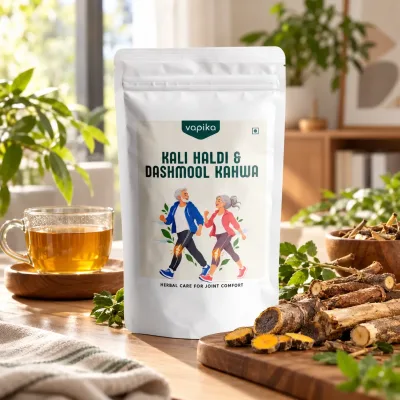
We sell it on its own as Dashmoola Kwath, and use it in our Kali Haldi & Dashmool Kahwa. Roots are tough, so both need a longer simmer than our other blends.
Dashamoola in our blends

From the texts: Caraka Saṃhitā, Sūtrasthāna 4 (the ten together as one mahākaṣāya, śvayathuhara); Suśruta Saṃhitā, Sūtrasthāna 38 (bṛhat and laghu pañcamūla).
For learning, not diagnosis. If you are pregnant, nursing or on medication, please speak to your doctor first.