
Butterfly pea
The deep-blue flower of a garden vine, offered to Shiva and Durga. It brews a blue cup that turns violet with a squeeze of lemon.
- Settles Pitta
- Settles Kapha
How Ayurveda reads butterfly pea
- Rasa · taste
- Bitter, astringent (tikta, kaṣāya)
- Guṇa · nature
- Light, dry (laghu, rūkṣa)
- Vīrya · potency
- Cooling (śīta)
- Vipāka · after digestion
- Pungent (kaṭu)
- Part used
- Flower
Reviewed by the Vapika team.
In the tradition
Aparājitā, "the unconquered", is a name of the goddess, and the blue flower is offered to Durga at Navaratri and to Shiva on Mondays. It grows as a vine over fences across India, in blue and in white.
The texts describe aparājitā with a white and a blue kind. In some regions the white one is sold as shankhpushpi, a different herb in the classical lists.
How Ayurveda reads it
Aparajita is bitter and astringent, light and dry, and cooling. It is described as settling Pitta and Kapha, and Bhāvaprakāśa calls it medhya, good for the mind.
In the Indian kitchen
The flowers are rarely cooked in India, but in Southeast Asia they colour rice blue (nasi kerabu in Malaysia) and desserts. In India they are now used for blue tea and blue lemonade.
How we use it
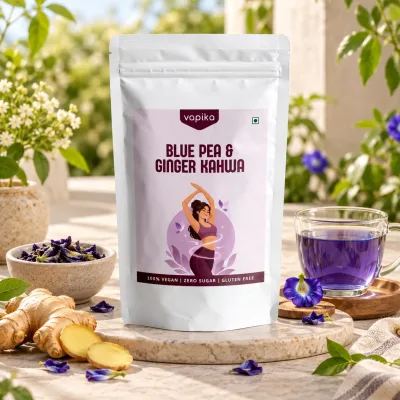
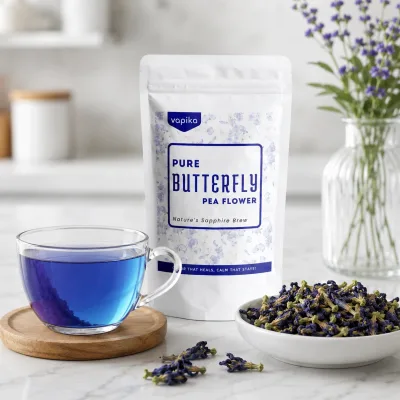
We sell whole dried flowers on their own, and use them in our Blue Pea & Ginger Brew. The blue is a natural pigment that turns violet, then pink, when it meets acid.
Butterfly pea in our blends
From the texts: Bhāvaprakāśa Nighaṇṭu, Guḍūcyādi varga (aparājitā).
For learning, not diagnosis. If you are pregnant, nursing or on medication, please speak to your doctor first.